
Tell Me Why?

An informative site covering interesting and factual topics with concise answers to pondering questions. Tap into the collective wisdom of factual knowledge designed to educate all knowledge seekers. Tell Me Why: Answer your Questions and Satisfy your Curiosity. New content is published once each week.
Free Stuff | How To Use Site |
 Top News Videos
What is the difference between a bacteria and a virus?
Published Friday, December 22, 2006 by R. Edmondson | E-mail this post

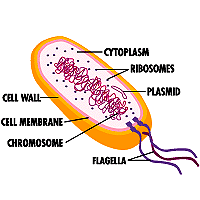 Bacteria are tiny, one-celled living organisms with a tail like structure that they use to swim (flagella). They can only be seen with the aid of a microscope. They live and breed in warm, moist environments in the body and other places, where they grow quickly, causing an infection. They reproduce by a process called Binary fission. This a method of asexual reproduction (reproduction occurring without the sexual union of male and female gametes) that involves the splitting of a parent cell (one-celled organism) into two daughter cells (their offspring). Structurally they usually have an enclosed cell wall and can appear in different shapes such as rodlike, spherical and spiral. Bacterial infections can usually be treated with an antibiotic.
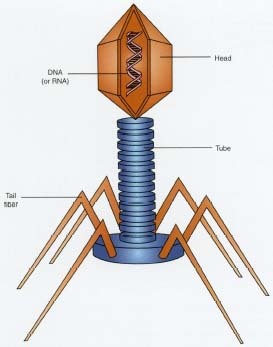 Viruses are smaller than bacteria and cannot be seen with a ordinary microscope (only with an electron microscope). They grow inside the body and produce toxins (poisons) that can cause infection. Viruses can not self-reproduce outside a cell of an organism (the host). They can only reproduce by using the cellular mechanism system of their host to reproduce. Structurally, virus do not have a cell wall and consist of a genetic material (DNA or RNA) that is enclosed by a protective coat of protein. This means, they may appear in several different shapes since they are not restricted by a cell wall. They can be rod-shaped, sphere-shaped or multisided. Viruses cannot be killed with antibiotics.
 You can read and learn more about bacteria and virus by visiting my other site Did You Know?.
Labels: Biology, Microorganism, Science
| Headline | Using Site | MyGame |
|

Message from the Author

Thanks for stopping by my site. I hope you will find this site interesting and informative and that you do learn something before you leave here. Please take the time to drop me a few lines and do come again. |
|
|
Last Questions Answered

Archives of Knowledge

Click Menu Tab To View
- Scholarships for College
- Scholarship Experts
Loans for College
- Consolidate Student Loans
- Student loans- Save more
A. Educational Sites
- World Clock
- How Stuff Works
- Online Study Programs
- Eassy Writing Tips
- The Library of Congress
B. Educational- Commercial
- Amazon.com: Textbooks...
- eCampus.com: books...
- Abebooks.com
- eBay's Half.com
- Learn Spanish Quickly
- Finish College Fast

C. Freebies Stuff
- Free Custom Print Products!
- Free Health sample products
- Tell Me Why Free Stuff
~Free Blog & Website Tools~
- Free Tools and Services
~Web Tools~
- Free Alexa Toolbar
 Subscribe To Tell Me Why:
| Click The [+] To Subscribe | [−] |


| Site Awards & Recognition | [−] |

March 19, 2007 ------------------------------------

Category: Best New Blog 2006 ------------------------------------

November 8, 2007 ------------------------------------

November 15, 2007 ------------------------------------

------------------------------------
 ------------------------------------
| This Site Is Approved By: | [−] |


| Science News Of Interest | [−] |



0 Responses to “What is the difference between a bacteria and a virus?”
Leave a Reply