
Tell Me Why?

An informative site covering interesting and factual topics with concise answers to pondering questions. Tap into the collective wisdom of factual knowledge designed to educate all knowledge seekers. Tell Me Why: Answer your Questions and Satisfy your Curiosity. New content is published once each week.
Free Stuff | How To Use Site |
 Top News Videos


 Phobia is used to describe a persistent, abnormal, and irrational fear of a specific thing or situation that compels one to avoid it, despite the awareness and reassurance that it is not dangerous. Therefore it is an exaggerated, often disabling fear usually unclear to the subject. This common type of anxiety disorder is characterized by physiological symptoms such as; rapid heartbeat, tremulousness (trembling or shaking), flushing of the face, hot or cold flashes, perspiration (sweating), shortness of breath or smothering sensation, stomach disorders, nausea, elevated blood pressure, choking feelings, diarrhea, frequent urination, and faintness or dizziness.
Some common phobias are: acrophobia - fear of heights; claustrophobia - fear of closed places; europhobia/ailurophobia - fear of cats; xenophobia - fear of strangers; hemophobia - fear of blood and agoraphobia - fear of leaving a safe place (the familiar setting of the home).
Phobias are placed into three categories:
1. Specific phobias - fear of a single specific panic stimuli e.g. flying
2. Agoraphobia - (a generalized fear) fear of open or public spaces e.g. fear of leaving home.
3. Social phobias - fear of being with other people and social relationships e.g. Enochlophobia - Fear of crowds.
Treatment:
Systematic desensitization or exposure therapy is a technique used to treat phobias. It is a type of cognitive behavioral therapy (CBT). CBT (or other behavior therapies) are sometimes combined with medication. Treatment will usually depend on the severity of the phobia.
Related Article:
Phobias - What's Your Fear?
Labels: Health, psychology, Science, Sociology
 Hemophilia (hee-muh-fil-ee-uh), is a hereditary bleeding disorder. This inherited condition results from the lack of particular clotting factors (a clotting protein) in the blood. The clotting factors are responsible to stop the bleeding when a blood vessel is torn by an injury. Clotting factors work together with platelets (thrombocytes ) to help the blood clot. Platelets (small cell fragments in the blood) function is to stop bleeding by sticking together to plug cuts and breaks at the site of the injury. The clotting factors (proteins) combine with the platelets to form fibrinogen which makes fibers (a net structure) that will stop the bleeding and allow the injured blood vessel to heal.
There are two main types of hemophilia (UK spelling: heamophilia) : hemophilia A (classical hemophilia, or Factor VIII deficiency) and hemophilia B (Christmas disease, or Factor IX deficiency). Hemophilia C has a lack of the clotting Factor XI. Clotting factors is identified by Roman numerals - Factor VIII, IX, X, XI. Hemophilia A is the most common form, where it is observed in ninety (90) percent of hemophiliacs followed secondly by hemophilia B.
Hemophilia occurs almost exclusively in men and boys, in which the blood clots much more slowly than normal, resulting in an extensive bleeding from even minor injuries. People with severe hemophilia are at risk of having life-threatening internal bleeding, whether they have been injured or not. They can also suffer from excessive bleeding caused by trauma and bruises.
 Hemophilia is linked to a recessive gene on the X-chromosome whereby the disease is carried through the female but affects only male offspring. That is, it affects males while females on the other hand, act as carriers - passing on this defect in the genes from mother to son. These genes are located on the X chromosomes (a thread like structure that contain many genes which make a long continuous molecule of tightly coiled DNA). Females have two X chromosomes (X X ) and males have one X and one Y chromosome. Males get an X chromosome from their mother and a Y chromosome from their father. Females get an X chromosome from their mother and a X chromosome from their father.
A female who is a “carrier” of hemophilia, has the abnormal (defected) gene on one of her X chromosomes. This is because the other X chromosome carries the genes responsible for production of factor VIII or factor IX (clotting factors). The female will therefore will not have or suffer from this illness. For this this to happen both X chromosomes must have the abnormal gene which is very rare - It can happen for example, if the female father has hemophilia and her mother is a carrier. A male who has the abnormal gene on his X chromosome will have hemophilia. A male on the other hand, who has the abnormal (defected) gene on his X chromosome will have hemophilia. This is due to the fact that the Y-chromosome has no gene for factors VIII or IX that can compensate for the X chromosome deficiency.
Hemophilia can be mild, moderate, or severe. This will however depend on the amount of clotting factor that is present in the blood. Diagnosis for the disease will require several blood tests that includes a complete blood count (CBC), activated partial thromboplastin time (PTT), prothrombin time (PT), as well as, the level of the amount of factor VIII and factor IX present in the blood.
The general signs and symptoms of hemophilia are excessive bleeding and easy bruising of the skin. It can be internal or external. Excessive bleeding can be for example, from the mouth, nose, knees, elbows and other joints, as well as, from the kidneys, bladder, intestines, stomach and brain. There is no cure at present for hemophilia. The main treatment for hemophilia is done by regular injections of the deficient clotting factor ( factor VIII in haemophilia A or factor IX in hemophilia B).
Labels: Biology, Health, Science
 A burp (sometimes called a belch or by its medical term, eructation) is the release of gas from the digestive tract (in this case, the esophagus and stomach) through the mouth. It is part of the body natural clearing mechanism for removing excessive gas in the digestive tract (gastrointestinal tract).
There are number of different factors that causes burping or belching. The most common one is the swallowing of air while eating or drinking. When you eat or drink, you swallow air at the same time as you swallow your food or liquid. The trapped air (gases such as nitrogen and oxygen) in the stomach build up and rise to the upper stomach creating a pressure in surrounding area thus, causing a sensation of the need to belch. This excessive gas accumulation is then forced (regurgitated) out of the stomach and released (belched) back up for relief through the esophagus and eventually through the mouth as a burp. Interestingly, burping can be caused by swallowing air (aerophagia) when one is nervous or anxious and even unconsciously out of habit. Drinking carbonated beverages (e.g. sodas, beer and champagne containing carbon dioxide to make it fizzy), talking while eating, eating too fast, chewing gum, sucking through a straw, sucking candy, chewing tobacco, smoking a pipe or cigarettes as well as, eating onions, chocolates and drinking alcohol are some other causes that can cause (trigger or aggravate) belching. Burping (belching) can sometime be a symptom of indigestion.
Burping can also be caused intentionally from being humorous or through learned behaviors. It can be done intentionally out of entertainment of being humorous by children and some adults alike. In some eastern cultures, a belch after a good meal is considered to be a compliment for the chef. It is as a sign showing appreciation of a satisfied eater. However, in the Western world, burping out loud is considered impolite - rude and poor manners. Therefore, burping quietly and covering ones mouth is important and should be accompanied by saying "excuse me" whether your burp is loud or quiet.
Labels: Biology, Health, Science
 Children usually start loosing their baby teeth (primary teeth) anywhere between the age of 6 to 7 years where their jaws have grown to its mature size. The reason for this is that the jaw of a baby is too small to accommodate permanent teeth anywhere below this age. During this time period, the babys' tooth root begins to dissolve (the erupting permanent tooth cause the root of the baby tooth to be resorbed) resulting in the tooth to begin to get loose. The loose baby tooth (primary tooth) over time will then eventually falls out since there are less root present to secure the baby tooth as the permanent tooth pushes upward. However, as the child grows the child’s jaw and jaw muscles matures grow to the required size and strength that is needed to support permanent teeth. This set the initial stage for permanent teeth development that will continue for that child for the next 15 or 16 years (depending on when the teeth begins to get loose and fall out).
Baby teeth are responsible for providing space for the growth of permanent teeth (adult teeth)
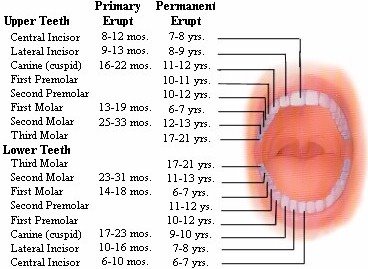 that will guide it into their proper position in the jaw. After baby tooth has fallen out, then a permanent tooth will take its place and begin to push through the baby’s gum. This process begins between the ages of 6 to 9 where the incisors and first molars start to come in. The two front teeth (central incisors) on the bottom (which are the first to fall out) as well as, the first molars at the top and lower jaw, are the first teeth to be replaced by permanent teeth. The canines (cuspids) and molars (the first and second premolars and second molars) aren’t replaced (erupt) until age 10-13. (see diagram).
Labels: Biology, Health, Science
| Headline | Using Site | MyGame |
|

Message from the Author

Thanks for stopping by my site. I hope you will find this site interesting and informative and that you do learn something before you leave here. Please take the time to drop me a few lines and do come again. |
|
|

Last Questions Answered
- What are Shooting Stars?
- What is the difference between practice and practise?
- Why is space black?
- What is the Miranda warning?
- What’s the difference between the words its and it's?
- Is there a difference between an emoticon and a sm...
- How do Astronauts communicate in space?
- Is there sound in space?
- When was slavery abolished in the US and what did ...
- What does it mean by a country having its independ...

Archives of Knowledge

Click Menu Tab To View
- Scholarships for College
- Scholarship Experts
Loans for College
- Consolidate Student Loans
- Student loans- Save more
A. Educational Sites
- World Clock
- How Stuff Works
- Online Study Programs
- Eassy Writing Tips
- The Library of Congress
B. Educational- Commercial
- Amazon.com: Textbooks...
- eCampus.com: books...
- Abebooks.com
- eBay's Half.com
- Learn Spanish Quickly
- Finish College Fast

C. Freebies Stuff
- Free Custom Print Products!
- Free Health sample products
- Tell Me Why Free Stuff
~Free Blog & Website Tools~
- Free Tools and Services
~Web Tools~
- Free Alexa Toolbar
 Subscribe To Tell Me Why:
| Click The [+] To Subscribe | [−] |


| Site Awards & Recognition | [−] |

March 19, 2007 ------------------------------------

Category: Best New Blog 2006 ------------------------------------

November 8, 2007 ------------------------------------

November 15, 2007 ------------------------------------

------------------------------------
 ------------------------------------
| This Site Is Approved By: | [−] |


| Science News Of Interest | [−] |


