
Tell Me Why?

An informative site covering interesting and factual topics with concise answers to pondering questions. Tap into the collective wisdom of factual knowledge designed to educate all knowledge seekers. Tell Me Why: Answer your Questions and Satisfy your Curiosity. New content is published once each week.
Free Stuff | How To Use Site |
 Top News Videos
What does it mean by a country having its independence?
Published Friday, November 16, 2007 by R. Edmondson.

 Independence is the self-government of a nation or country. It is one in which a country has its own government, and rules itself by being free from subjection or from the influence, control, or guidance of other state or country. Therefore a country having its’ independence (political freedom) is governed by its people (i.e its residents). Thus, each country that was once under the control of another country or state will have an independence day. This is the date in which that country achieves its political independence. As such, an independence day is a day on which a country celebrates its independence from foreign rule.
A country for example, can be controlled by another through colonialism, expansionism or imperialism.
Related Article:
What is Social Darwinism?
Labels: Geography, Physical Geography
 Hydro-power is the capture of the energy (by means of waterwheels or hydraulic turbines) of moving water (falling or flowing water) to generate electric power. This falling of water can be from a natural falling source or from a dam. The falling water is used to turn waterwheels or modern turbine blades which is used to power a generator to produce electricity. A water turbine, for example, captures the energy in the falling water and converts the hydraulic energy into mechanical energy at the turbine shaft. The turbine then powers an alternator which converts mechanical energy into electrical energy. The water power is used to generate electric power. This electricity produced by hydro-power is called Hydroelectricity.
Hydro-power system (hydroelectric power) is a clean source of energy systems that can neither pollute or be consumed during its operation. It eliminates the cost of fuel, making it immune to price increases for fossil fuels. The same applies to nuclear power which generates very dangerous nuclear waste. As long there is a water source (lake, river etc.) it is renewable - a renewable energy source.
Related Articles:
What is Wind Power?
How deep is the Ocean?
Labels: Geography, Physical Geography, Science
What's the difference between Weather and Climate?
Published Friday, August 17, 2007 by R. Edmondson.
 Weather is the specific day-to-day conditions of the atmosphere at a particular place and time. It describes the state of the atmosphere with regard to meteorological conditions (variables) such as; wind (speed, direction, calm or stormy), temperature (heat or cold), humidity, atmospheric pressure, visibility (clear, misty or foggy), cloud cover (clearness or cloudiness), and precipitation (rain, snow, hail, sleet, fog, or dew). Weather describes and measures the short-term variations of the atmosphere which can change hourly, daily, and seasonally. Weather keeps changing all day. For example: It was raining today at school. It was raining this morning but by afternoon it is bright and sunny.
On the other hand, climate tells the normal pattern of weather (i.e common, average weather conditions) experienced in a particular area over a long period of time. Climate uses all these average weather conditions over long period of time to describe the weather that a particular region will experience all year round. As such, climate stays much the same year after year and gives a general all year round weather of how hot, cold or wet different parts of the world will be at different times of year. There are different climates around the world and a particular region may experience the four seasons a year - spring, summer, autumn and winter. For example, the climate in the US is warm in the summer but cool in the winter. The Arctic always has a very cold climate.
Hence, the difference between weather and climate is a measure of time. Weather changes on a daily basis. It gives the current atmospheric conditions of a place over a short-term (minutes to weeks). While on the other hand, climate describes the typical weather (state) a location will have over a long period of time (more of a permanent state).
Related Articles:
What is the Greenhouse Effect?
What is Wind Power?
What is Global Warming?
What is Climate?
What is Weather?
Why are some clouds dark in appearance?
Why are Clouds White?
Why is the Sky Blue?
What causes thunder?
What is a rainbow?
Labels: Geography, Physical Geography
 A cloud is a visible mass of water (tiny water droplets and/or ice crystals) suspended in the atmosphere at a considerable altitude. Clouds are usually white in appearance whereas others can appear grayish and darker. From a previous post “Why are Clouds White?” it was explained that clouds are white because they scatter and reflect all the visible colors of light, which together add up to give white light. That means clouds are white because they reflect the white light from the sun.
Now, if a cloud is very thick (filled with a lot of water particles), sunlight will have to travel through a lot of water droplets before reaching the observer eye whereby a significant amount of the light is absorbed by the cloud. This will therefore cause clouds to appear very dark because of the lack of sunlight passing through it. Thus, clouds can appear dark in appearance taking on the color grey or black which will depend on the amount of sunlight passing through it, in relation to the thickness of the cloud.
Related Articles:
Why are Clouds White?
Why is the Sky Blue?
What is a rainbow?
Where do objects get their colors from?
Labels: Geography, Physical Geography, Science
 A cloud is a visible accumulation of very tiny water droplets or solid ice crystals that float in the air (troposphere). Clouds are usually white in appearance due to the fact that it reflects (scatter) all the visible wavelengths of light from the sun.
The sun’s light, as explained in a previous post Why is the Sky Blue?, is made up of different colors (rainbow colors) that appear as a white light when combined. These colors can be demonstrated using a prism that scatters the Sun’s light (white light ).
 The water droplets or ice crystals that make up the cloud reflect all the light of the seven visible wavelengths (red, orange, yellow, green, blue, indigo, and violet) all together without dispersing each color. Thus, clouds are white because they effectively reflect the wavelengths of visible light spectrum of the sun (called Mie scattering) in all directions more or less equally.
Related Articles:
Why is the Sky Blue?
What is a rainbow?
Where do objects get their colors from?
Labels: Colors, Physical Geography, Science
Click image to enlarge
 This is necessary since eventually the earth would be too hot to support life. Some of the re-emitted radiation escapes into space (a small amount) while the rest is reflected back to earth by gases in the atmosphere. These gases (called green houses gases) traps the heat (radiation) that would normally escape the atmosphere and goes back into space. These gases act in a way similar to the glass in a greenhouse whereby the Sun’s heat is allowed in but cannot get out thus, the 'Greenhouse Effect'. The green houses gases acting as a form of blanket helps to keep the earth an average of 33 °C warmer. If this greenhouse effect did not occur then Earth would be at least 33°C cooler and too cold to sustain life on Earth. Life on earth would not exist since it would be freezing cold and covered in ice. Therefore, the greenhouse effect keeps the Earth warm.
Related Articles:
What is Global Warming?
What is Climate?
What is Weather?
What causes thunder?
Why is the Sky Blue?
What is a rainbow?
Labels: Geography, Physical Geography, Science
 Wind power is the conversion of wind energy into electricity using wind turbines (usually mounted on a tower). Wind power is used in large scale wind farms for national electrical grids. On a small scale it is also used to provide electricity to rural residences. The US accounted for about 14 % of the world’s operating wind capacity in 2005. Wind energy is ample, free, widely available, clean, renewable, produces no waste or greenhouse gases, need no fuel, good method of supplying energy to remote areas and can be site for tourist attraction.
Labels: Geography, Physical Geography, Science
 Global warming is the term applied to an increase in the overall temperature of the earth. More precisely, it is a significant sustained increase in the average temperature of Earth’s landmasses, oceans, and atmosphere which causes climatic changes relatively over a short period of time as a result of the activities of humans. Human activities since the Industrial Revolution as resulted an increase in greenhouse gases. This buildup of greenhouse gases result an increase in the world's temperatures by a process known as the greenhouse effect.
Just a small rise in temperature ( 2° F or 1.1°C) can have serious effect on climatic conditions and weather changes. This could affect the frequency and severity of storms, hurricanes and tornados, distort seasons duration, increased cloud cover, change in precipitation level and wind pattern. Warmer sea surface temperatures will cause frequent and more storms and hurricanes along the
Gulf coasts and southeastern Atlantic.
Labels: Geography, Physical Geography, Science
 Climate is the average weather conditions of a place, usually measured over one year. In other words, it describes the total of all weather (trends in weather patterns) occurring over a period of years in a given place. It therefore tells us what it's usually like in a region over a long period of time. For example, the climate in the US is warm in the summer but cool in the winter. Another example: Jamaica, a tropical country, is known as having a hot climate.
Related Articles:
What is Weather?
Labels: Geography, Physical Geography, Science
 Weather is the day-to-day state of the atmosphere and its short-term variations (which can be in minutes, hours, days and weeks) at a given place and time. The weather’s short-term variations include daily changes in precipitation, barometric pressure, cloudiness, humidity, temperature, rainfall, wind and other meteorological conditions in a given location. Therefore, the weather can change a lot within a very short time and this is what we are informed about on the weather news channel. For example, it may rain in the morning and then become sunny and clear in the afternoon.
Labels: Geography, Physical Geography, Science
 Geography is generally the scientific study of the environment and its habitants by bridging the social sciences (Human Geography) and the earth sciences (Physical Geography). Human geography (sometimes called Cultural Geography) is concerned with the study of cultures, history, political structures, economic activities, nations, settlements, lines of communication, transportation, buildings, and other such aspects that involves all phases of human social life in relation to the physical earth. Human geography provides an understanding of how all these aspects affect the location and spatial organization of people and their activities on Earth. Physical geography is the branch of geography that studies the natural features of the Earth's surface as well as their formation. Physical geography is concerned with the study of the natural environment; climate and weather patterns, earth-sun interaction, land forms, soils, rocks, vegetations, water, plant and animal life.
The ancient Greeks created the word "geography" from the Greek words "geo" or "ge" both meaning "Earth" and "grapho" meaning "to write" and graphein meaning "to describe" or "to write.”
Hence, Geography describes and analyses the variable character, from place to place on earth whereby studying many aspects of the physical and cultural environment that are significant to understanding the character of areas or the spatial organization of the world. Thus, it is defined as the study of spatial variation, of how and why things differ from place to place on the surface of the earth, as well as, the study of how observable spatial patterns evolved through time.
Related Articles:
What is the difference between an ocean and a sea?
How deep is the Ocean?
From Did You Know? site:
Earth's Deepest Oceans and Seas
Why is the Sea Salty?
What happens to marine life when a lake or pond is frozen?
How Do Fish Breathe?
Labels: Geography, Physical Geography
What is the difference between an ocean and a sea?
Published Friday, March 02, 2007 by R. Edmondson.
 Ocean and sea are two words that are used frequently and interchangeably (in writing and conversation) to mean the same thing: a continuous mass of seawater on the earth's surface. However, strictly speaking, there is a difference between the two.
An ocean is a large expanse of salt water that covers three-quarters of the earth's surface. It is bounded by the continents, or the equator, and other imaginary lines. The Earth's seven main oceans are; the Arctic, North Atlantic, South Atlantic, North Pacific, South Pacific, Indian and Antarctic Oceans. These seven main oceans comprise the "world ocean". Sea on the other hand, is a body of salt water that is surrounded by land on all or most sides, or that is part of one of the oceans. For example, the Caspian Sea and the Dead Sea are large saline lakes that are surrounded by land-they lack a natural outlet; Sargasso Sea is a portion of the Atlantic Ocean and the Mediterranean Sea is attached to the Atlantic Ocean. Major seas include the Mediterranean, Baltic, Bering, Black, Caribbean, Coral, North, Red, and Yellow. The largest seas are the South China Sea, the Caribbean Sea, and the Mediterranean Sea.
Thus, an ocean is interconnected mass of saltwater (covering 71% of the surface of the earth) where boundaries are established by continental land masses, or the equator and ridges in the ocean floor. A sea, on the other hand, is usually smaller than an ocean (a division of an ocean) and is a body of salt water that is; surrounded on all or most sides (partially enclosed) by land and/or part of one of the oceans.
Related Articles:
How deep is the Ocean?
From Did You Know? site:
Earth's Deepest Oceans and Seas
Why is the Sea Salty?
What happens to marine life when a lake or pond is frozen?
How Do Fish Breathe?
Labels: Geography, Physical Geography, Science
 The world's deepest point in the oceans is the Challenger Deep which is found within the Marianas Trench. The Marianas Trench is a depression (deep cracks) in the floor of the western Pacific Ocean. Marianas Trench is formed (as other ocean trenches) as a result of the oceanic plate being pushed against a continental plate whereby causing the oceanic plate to pushed downward making deep fissure. Its location is east of the Mariana Islands and is 1,554 miles long and averages 44 miles wide (see diagrams below). The Marianas Trench depth is 36,200 feet (11,033 m or 11.03 km).
[click to enlarge images]
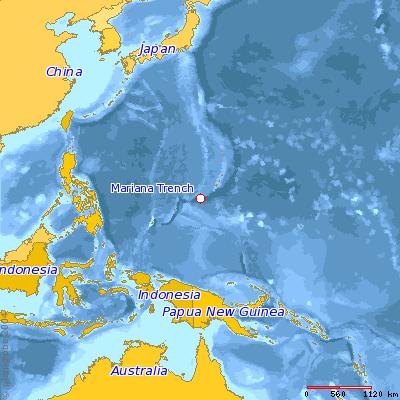
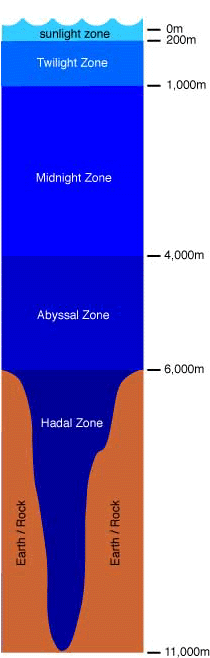 Marianas Trench is far (miles) beyond the reaches of sunlight where it can no longer penetrate the ocean. The seas' pressures at this depth is unimaginable. It is 8 tons per square inch or 16,000 pounds on every square inch. At this depth it also has very cold temperatures along with darkness. Imagine an underwater depth that is higher than the Eiffel Tower in Paris, France which is 1,052 ft (321m) or the Empire State building in New York, US which is 1,472 ft (449). It could take 5.4 Empire State Buildings in order to reach the bottom of the deepest ocean - the Mariana Trench. Better yet, the world's highest mountain, Mount Everest (29,141 feet), would be covered by over 1.25 miles of water.
Beneath this ocean surface at such a depth, lies an alien dark cold world with its own life where very eerie looking fishes and other life form can be found. It was once thought to be a lifeless place when it was discovered by the British survey ship Challenger II in 1951 (where it got its name). This belief of the deepest point on Earth being lifeless was however proven wrong in 1960 when Jacques Piccard and Navy Lt. Donald Walsh descended in the U.S. Navy Trieste, a bathyscaphe ("bathy" = deep & "scaphe" = ship), to the bottom of the Mariana Trench - Challenger Deep. The first and still the only manned vessel to go to its bottom. They provided the measurement for the depth of the Mariana Trench. Unmanned vessels have also recorded its measurement although they do not go as far as the Trieste.
Related Articles:
-From the Did You Know? site:
Why is the Sea Salty?
What happens to marine life when a lake or pond is frozen?
How Do Fish Breathe?
Collective Nouns for Fish - What Group of Fish are Called
Labels: Geography, Physical Geography, Science
 Thunder is caused by lightning. Lightning is a stream of electrons (electricity) flowing within or between clouds, or between a cloud and the ground (usually occurring during a thunderstorm). When a bolt of lightning shoots through the atmosphere, it rapidly heats the air up to 50,000 degrees Fahrenheit (five times the temperature of the sun) in a fraction of a second (almost instantaneously). This superheated air rapidly expands thus opening up a little hole (a partial vacuum) in the air surrounding the lightning's path, called a channel. As the superheated air quickly dissipates it's heat (cools), the air rapidly collapses (contracts), creating a tremendous shock (compress) wave. This loud cracking sound wave, is what we hear as thunder. The rumbling sound has to do with the sound echoes and reverberates as the vibrations gradually die out over distance.
The reason we see lightning before we hear thunder is because light travels faster than sound. Thunder typically can be heard 10 to 15 miles away from a thunderstorm.
Labels: Geography, Physical Geography, Science
 A rainbow is an arc or bow of light separated into concentric bands of several colors that exhibits the range (visible light spectrum) of colors - red, orange, yellow, green, blue, indigo, and violet in that order. It appears (created) when the Sun's light rays are refracted and reflected (called dispersion of light) by drops of mist or rain (water droplets) falling or floating through the air (atmosphere). It is usually visible in the sky opposite to the sun during or immediately after a rain shower. It can also be seen in the spray of waterfalls when viewed with the sun behind the observer. Thus, rainbow in simpler terms, is a multicolored concentric arc or bow in the sky that is formed (and visible) in part of the hemisphere opposite to the Sun by the dispersion (refraction and reflection) of the sun's rays in drops of falling rain.
To learn more how a rainbow is formed, visit by other site (Did You Know?) and read the article: How Rainbows are Formed - What Causes A rainbow?
Labels: Colors, Geography, Physical Geography
| Headline | Using Site | MyGame |
|

Message from the Author

Thanks for stopping by my site. I hope you will find this site interesting and informative and that you do learn something before you leave here. Please take the time to drop me a few lines and do come again. |
|
|

Last Questions Answered
- What are Shooting Stars?
- What is the difference between practice and practise?
- Why is space black?
- What is the Miranda warning?
- What’s the difference between the words its and it's?
- Is there a difference between an emoticon and a sm...
- How do Astronauts communicate in space?
- Is there sound in space?
- When was slavery abolished in the US and what did ...
- What does it mean by a country having its independ...

Archives of Knowledge

Click Menu Tab To View
- Scholarships for College
- Scholarship Experts
Loans for College
- Consolidate Student Loans
- Student loans- Save more
A. Educational Sites
- World Clock
- How Stuff Works
- Online Study Programs
- Eassy Writing Tips
- The Library of Congress
B. Educational- Commercial
- Amazon.com: Textbooks...
- eCampus.com: books...
- Abebooks.com
- eBay's Half.com
- Learn Spanish Quickly
- Finish College Fast

C. Freebies Stuff
- Free Custom Print Products!
- Free Health sample products
- Tell Me Why Free Stuff
~Free Blog & Website Tools~
- Free Tools and Services
~Web Tools~
- Free Alexa Toolbar
 Subscribe To Tell Me Why:
| Click The [+] To Subscribe | [−] |


| Site Awards & Recognition | [−] |

March 19, 2007 ------------------------------------

Category: Best New Blog 2006 ------------------------------------

November 8, 2007 ------------------------------------

November 15, 2007 ------------------------------------

------------------------------------
 ------------------------------------
| This Site Is Approved By: | [−] |


| Science News Of Interest | [−] |



