
Tell Me Why?

An informative site covering interesting and factual topics with concise answers to pondering questions. Tap into the collective wisdom of factual knowledge designed to educate all knowledge seekers. Tell Me Why: Answer your Questions and Satisfy your Curiosity. New content is published once each week.
Free Stuff | How To Use Site |
 Top News Videos


 A burp (sometimes called a belch or by its medical term, eructation) is the release of gas from the digestive tract (in this case, the esophagus and stomach) through the mouth. It is part of the body natural clearing mechanism for removing excessive gas in the digestive tract (gastrointestinal tract).
There are number of different factors that causes burping or belching. The most common one is the swallowing of air while eating or drinking. When you eat or drink, you swallow air at the same time as you swallow your food or liquid. The trapped air (gases such as nitrogen and oxygen) in the stomach build up and rise to the upper stomach creating a pressure in surrounding area thus, causing a sensation of the need to belch. This excessive gas accumulation is then forced (regurgitated) out of the stomach and released (belched) back up for relief through the esophagus and eventually through the mouth as a burp. Interestingly, burping can be caused by swallowing air (aerophagia) when one is nervous or anxious and even unconsciously out of habit. Drinking carbonated beverages (e.g. sodas, beer and champagne containing carbon dioxide to make it fizzy), talking while eating, eating too fast, chewing gum, sucking through a straw, sucking candy, chewing tobacco, smoking a pipe or cigarettes as well as, eating onions, chocolates and drinking alcohol are some other causes that can cause (trigger or aggravate) belching. Burping (belching) can sometime be a symptom of indigestion.
Burping can also be caused intentionally from being humorous or through learned behaviors. It can be done intentionally out of entertainment of being humorous by children and some adults alike. In some eastern cultures, a belch after a good meal is considered to be a compliment for the chef. It is as a sign showing appreciation of a satisfied eater. However, in the Western world, burping out loud is considered impolite - rude and poor manners. Therefore, burping quietly and covering ones mouth is important and should be accompanied by saying "excuse me" whether your burp is loud or quiet.
Labels: Biology, Health, Science
 Every object in nature is composed of various chemical elements and as such, these elements and their combinations have varying degrees of light ray absorption, as well as, that which is reflected. Thus, depending on the elements contained by any object, this will determine its own distinctive color. For example, a red apple absorbs all colors except red, and reflects the red
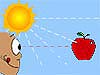 light waves back to our eyes and we see and say the apple is red. Also, If no light is absorbed, the object appears to be colorless. If an equal amount of all colors from the sunlight is reflected off the object, then that object will appear white. If all colors are absorbed by the object, then the object will appear black because all colors are absorbed, leaving nothing to be reflected. So, the splendid colors that poured down to earth in the form of white light from the sun is what allows us to see a variety of colors through our eyes which is interpreted by our brain, allowing us to see colors.
Labels: Colors
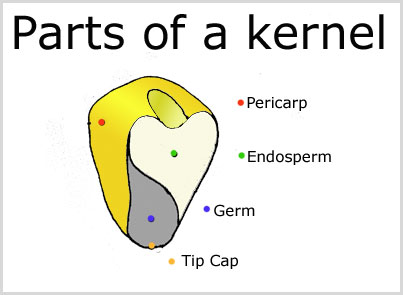 A popcorn kernel is a cereal grain (seed). It is made up of four major physical structures: (1) The Pericarp (seed coat or outer hull): a hard outer thin covering. (2) The Endosperm: starchy part that forms the bulk of the kernel and consists almost entirely of starch along with smaller amounts of protein, fat, minerals and water. This water plays an important role in the popping process of popcorn. (3) The Germ (embryo): The rudimentary (partially developed) plantlet within the seed. This is the structure that develops and grows into a new plant when it is planted. (4) Tip Cap: the part where the kernel joins (attaches to) the cob.
 When the kernel is heated (to about 400 degrees Fahrenheit) the small amount of water (13-14%) stored inside the starchy endosperm turns into vapor (steam) causing it to expand (about 40 or 50 times its original size). As the water (steam) expands it puts pressure against the hard starch in the endosperm causing it to become inflated. Eventually, this causes the pericarp of the kernel to give way (to the pressure from the built up steam) causing it to explode (pop) as it flips inside out allowing the steam to escape and expose the soft white fluffy starch known as popcorn.
However, in order for popcorn to pop successfully, there must be certain ideal factors:
- The amount of moisture (water) in the kernel must be between 13 to 14 percent. Although
 popcorn are usually harvested when the moisture content is between 16-19% (by mass), they are carefully cured or dried until the ideal moisture content is reached. Too little moisture and there would not be enough steam to carry out the popping process and if there is too much moisture, the popcorn will crack prematurely exposing a dense sphere with the starch not properly cooked rather than the ideal soft white fluffy popcorn.
 - The pericarp of the kernel must have high mechanical strength. That is, it must be very strong (tough). This is necessary to withstand (retain) the steam pressure buildup until it reaches the ideal pressure where the starch is cooked and it is strong enough to burst the strong pericarp wall of the kernel at the right time exposing the soft, white and fluffy popcorn.
- The pericarp must not contain any cracks or any damage. If it does, then the steam will escape when it is heated preventing the build up of steam pressure that is needed to burst the pericarp of the kernel properly.
- The temperature must be above 300 degrees F for the popcorn to pop. Popcorn has to be at a certain temperature (about 400 degrees F) so that it is possible for the steam pressure inside the kernel to buildup to the point where starch is properly cooked and it can pop (burst) the strong outer casing (pericarp) of the kernel.
 A rainbow is an arc or bow of light separated into concentric bands of several colors that exhibits the range (visible light spectrum) of colors - red, orange, yellow, green, blue, indigo, and violet in that order. It appears (created) when the Sun's light rays are refracted and reflected (called dispersion of light) by drops of mist or rain (water droplets) falling or floating through the air (atmosphere). It is usually visible in the sky opposite to the sun during or immediately after a rain shower. It can also be seen in the spray of waterfalls when viewed with the sun behind the observer. Thus, rainbow in simpler terms, is a multicolored concentric arc or bow in the sky that is formed (and visible) in part of the hemisphere opposite to the Sun by the dispersion (refraction and reflection) of the sun's rays in drops of falling rain.
To learn more how a rainbow is formed, visit by other site (Did You Know?) and read the article: How Rainbows are Formed - What Causes A rainbow?
Labels: Colors, Geography, Physical Geography
 Children usually start loosing their baby teeth (primary teeth) anywhere between the age of 6 to 7 years where their jaws have grown to its mature size. The reason for this is that the jaw of a baby is too small to accommodate permanent teeth anywhere below this age. During this time period, the babys' tooth root begins to dissolve (the erupting permanent tooth cause the root of the baby tooth to be resorbed) resulting in the tooth to begin to get loose. The loose baby tooth (primary tooth) over time will then eventually falls out since there are less root present to secure the baby tooth as the permanent tooth pushes upward. However, as the child grows the child’s jaw and jaw muscles matures grow to the required size and strength that is needed to support permanent teeth. This set the initial stage for permanent teeth development that will continue for that child for the next 15 or 16 years (depending on when the teeth begins to get loose and fall out).
Baby teeth are responsible for providing space for the growth of permanent teeth (adult teeth)
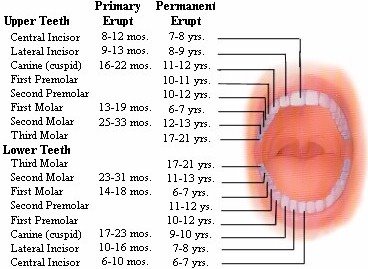 that will guide it into their proper position in the jaw. After baby tooth has fallen out, then a permanent tooth will take its place and begin to push through the baby’s gum. This process begins between the ages of 6 to 9 where the incisors and first molars start to come in. The two front teeth (central incisors) on the bottom (which are the first to fall out) as well as, the first molars at the top and lower jaw, are the first teeth to be replaced by permanent teeth. The canines (cuspids) and molars (the first and second premolars and second molars) aren’t replaced (erupt) until age 10-13. (see diagram).
Labels: Biology, Health, Science
| Headline | Using Site | MyGame |
|


Message from the Author

Thanks for stopping by my site. I hope you will find this site interesting and informative and that you do learn something before you leave here. Please take the time to drop me a few lines and do come again. |
|
|

Last Questions Answered
- What are Shooting Stars?
- What is the difference between practice and practise?
- Why is space black?
- What is the Miranda warning?
- What’s the difference between the words its and it's?
- Is there a difference between an emoticon and a sm...
- How do Astronauts communicate in space?
- Is there sound in space?
- When was slavery abolished in the US and what did ...
- What does it mean by a country having its independ...

Archives of Knowledge

Click Menu Tab To View
- Scholarships for College
- Scholarship Experts
Loans for College
- Consolidate Student Loans

- Student loans- Save more

A. Educational Sites
- World Clock
- How Stuff Works
- Online Study Programs

- Eassy Writing Tips
- The Library of Congress
B. Educational- Commercial
- Amazon.com: Textbooks...
- eCampus.com: books...
- Abebooks.com
- eBay's Half.com
- Learn Spanish Quickly
- Finish College Fast


C. Freebies Stuff
- Free Custom Print Products!
- Free Health sample products
- Tell Me Why Free Stuff


~Free Blog & Website Tools~
- Free Tools and Services
~Web Tools~
- Free Alexa Toolbar

 Subscribe To Tell Me Why:
| Click The [+] To Subscribe | [−] |


| Site Awards & Recognition | [−] |

March 19, 2007 ------------------------------------

Category: Best New Blog 2006 ------------------------------------

November 8, 2007 ------------------------------------

November 15, 2007 ------------------------------------

------------------------------------
 ------------------------------------
| This Site Is Approved By: | [−] |


| Science News Of Interest | [−] |


